
01
Original reporting
Someone goes, asks, records and publishes what was not previously on the record.
Inside one publication

A public framework
Information Governance is the shared stewardship of the conditions under which public knowledge is produced, verified, preserved, made accessible, connected and corrected.
AI can produce and distribute plausible material at a scale that weakens familiar signals of authorship, evidence and context. The response is not a verdict about what citizens should believe. It is a practical account of what an information environment must do so that judgement remains possible.
AI can generate, combine and distribute convincing material faster than people and institutions can examine it. Information Governance matters because citizens still need to know where claims came from, how they were tested, what context surrounds them and which perspectives may be missing.
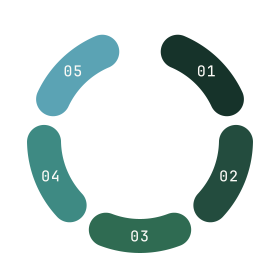
The framework describes observable functions rather than approved opinions. The open ring is deliberate: no institution completes the environment and the work is never finished.
Someone goes, asks, records and publishes what was not previously on the record.
Inside one publication
Claims are tested before they circulate, and the test leaves a trace a reader can inspect.
Inside one publication
A fact is placed among the facts that qualify it: its scale, trend, history and dispute.
Inside one publication
Different views remain within reach of one another, with shared evidence that keeps disagreement intelligible.
Between publications
Separate accounts are connected into the state of a question, not merely the state of its coverage.
Across the environmentAI did not create the weaknesses in today’s information environment, but it is accelerating many of them at once. Plausible material can be produced cheaply and at scale; automated summaries may separate answers from their sources; and familiar signals of authorship, evidence and context are becoming harder to read.
The answer is not to decide what people should believe. It is to sustain the conditions that make informed disagreement possible: original reporting, visible verification, meaningful context, diverse perspectives and synthesis that remains connected to its sources.
Information Governance gives institutions, researchers, platforms and citizens a shared way to examine those conditions. It makes responsibilities and gaps more visible while leaving judgement with the citizen.
The master publication develops the argument through five accessible lenses: what good public information contains, what citizens need to do with it, how responsibilities are shared, which institutions carry them, and how the health of the environment can be observed.
Anna Pereira reads the Wheel as a living system, while Dr. Barbara van Veen examines its human boundary through attention, knowledge and strategic foresight. Their signed companion publications extend and test the founding argument without being absorbed into it, so readers can follow where perspectives meet and where questions remain open.